Good morning, and welcome!
Yesterday, we spoke about consciousness. Erinnerungskultur, I realised, is much the same thing: an act of choosing to stay awake and remember. This tour grew out of that idea. It is intended to demonstrate how Hamburg engages with its past. A culture of remembrance keeps us mentally, morally and socially alert. It protects us from forgetting and thus from repeating mistakes, violence and injustice. It opens our hearts by fostering empathy, bringing stories to light and drawing a connection between past and present suffering. And it compels us to act, because it shows that inaction has consequences, motivates us to stand up against current injustices, and creates a shared moral foundation upon which we can take responsibility.
We are heading down to the harbour now, where you will enjoy a short boat tour showing you the heart of this city – as it has always been seen: from the water.
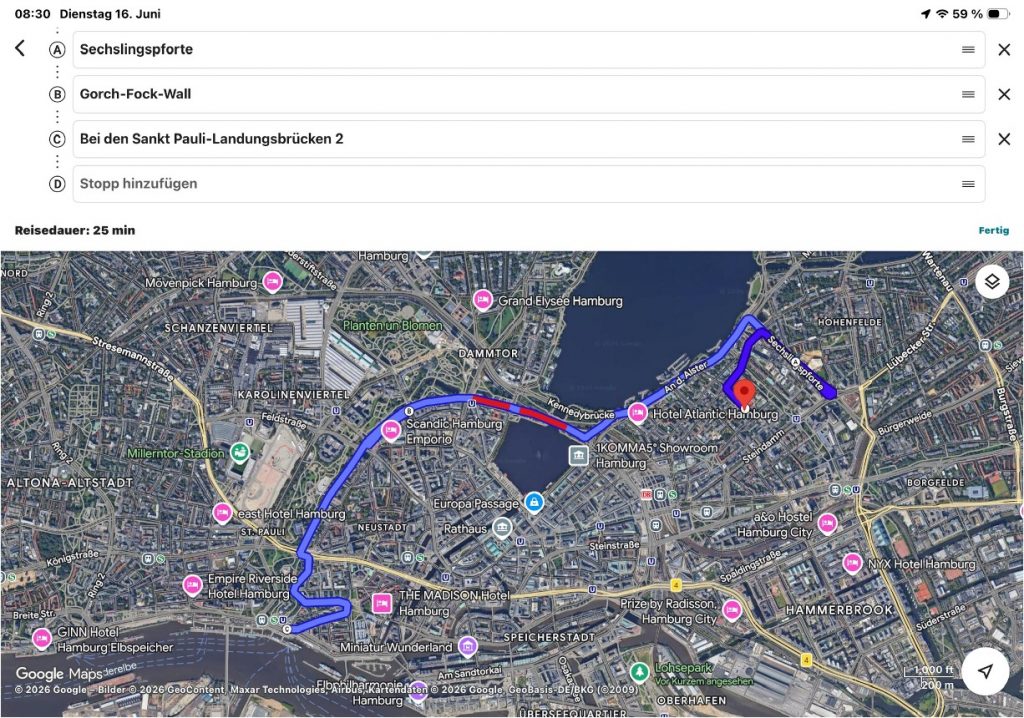
Think of this as the opening chapter of our programme that will introduce you to Hamburg’s culture of remembrance — its Erinnerungskultur, as the Germans call it — over the course of the next two hours. But that is for later. For now, we simply travel.
Almost immediately, the Alster opens up on your left. Hamburg could have based its identity on the harbour and the tidal reach of the Elbe, and on all the goods that arrived and departed there. Instead, the city chose this calmer body of water.
In 1235, a dam was built where the Jungfernstieg now runs, diverting the river to power the city’s mills. Over the centuries, the lake behind that dam grew into the Alster you see today. The townhouses along its banks reveal who benefited: merchants who made their fortunes abroad and came home to a quiet lake instead of the sea.
As we cross now, over the Lombardsbrücke or its younger twin, the Kennedybrücke, we are passing the exact line where Hamburg’s early seventeenth-century fortifications once stood. Built between 1615 and 1625, they ran straight through what had, until then, been a single, undivided lake. The wall split the water in two.
Behind us lies the smaller, more enclosed Binnenalster, framed by hotels and the Jungfernstieg. Ahead of us, opening up wide and ringed by villas and sailing boats, is the Außenalster — some 164 hectares of it. The stone bridge itself dates to 1865, and a second bridge was added beside it in 1953 to ease traffic. It was renamed the Kennedybrücke in 1963 following the assassination of the American president. Even here, a bridge carries more than cars.
The bus turns and Planten un Blomen comes into view. This Low German name means ‚plants and flowers‘, and gives no hint as to what the park used to be.
From 1820 onwards, Hamburg began tearing down its old city fortifications, and a botanical garden was established on part of the cleared land the following year.
Hamburg tore down its walls and planted flowers in their place. However, the flowers do not immediately reveal that part of this green belt, in the Wallanlagen just beyond, was Hamburg’s central execution site for the entire northern region from 1938 onwards.
Roughly 500 people were killed there under National Socialist rule. Three modest plaques, added in 1988, mark the spot today.
As this tour progresses, you will notice that Hamburg has a habit of building things up with great confidence and then quietly dismantling or overgrowing what came before. It is not always flowers that are planted in place of what has been removed.
To the left is the Laeiszhalle, the city’s concert hall. It was built between 1904 and 1908 using funds from the Laeisz shipping family, and was inaugurated on 4 June 1908. At the time, it was the largest and most modern concert hall in Germany. The Laeisz line built the Flying P-Liners, among them the Pamir, which they sold in 1931 and which sank in a hurricane in 1957 with the loss of 80 lives; the Peking, now a museum ship moored in Hamburg’s harbour since 2020; and the Padua, launched in 1926, which was handed over to the Soviet Union after the war and still sails today under Russian flag as the Kruzenshtern.
During the Nazi era, the Laeisz Hall was stripped of the Laeisz name and became known simply as the Musikhalle. It was not formally renamed Laeiszhalle again until 2005. It seems that not even a concert hall was exempt from the era’s habit of erasing names.
We continue past the courts on Sievekingplatz, three grand buildings erected in stages between 1879 and 1912. The square itself was named after the court’s first president. Only one of the neoclassical buildings had been completed. They were built to look as though the justice inside was as solid as the stone.
Beside the entrance to the Oberlandesgericht is an understated plaque which plainly states that, between 1933 and 1945, judges and prosecutors of the Hamburg judiciary stripped people of their rights, tormented them and sent some to their deaths.
A second memorial, added in 1997, stands opposite. We will have more to say about Hamburg’s justice system later in the tour. For now, we will only pass by. Remember the buildings.
To our right is the start of the world-famous Reeperbahn. The name has nothing to do with its later reputation.
From around 1630, rope-makers, or ‚Reepschläger‘, settled just outside the old city walls because laying out ship’s rope required long, straight stretches of ground — this street is one of those. The trade itself declined throughout the nineteenth century as sail gave way to steam, but the entertainment district that replaced it simply kept growing. The Star-Club once stood just off this street; a young, unknown band called the Beatles played there in 1960, long before anyone had heard of them.
And then, towering above everything else, is the Bismarck Monument — built between 1901 and 1906, unveiled on 2 June 1906. This thirty-four-metre granite structure was deliberately placed so that it would be the first thing sailors saw when arriving from the sea.
It was intended to serve as both a greeting and a warning. Since August 2025, new information panels at the site have set out its colonial dimension, its use under National Socialism and how its meaning has changed over time. To this day, it remains one of the most contentious monuments in Hamburg, serving as a memorial to unification that is also, unavoidably, a reminder of empire. Its legacy continues to be a subject of ongoing debate and reflection.
For more information: https://www.hamburg.de/politik-und-verwaltung/behoerden/behoerde-fuer-kultur-und-medien/themen/koloniales-erbe/entwicklung-hamburger-bismarck-denkmal-110434
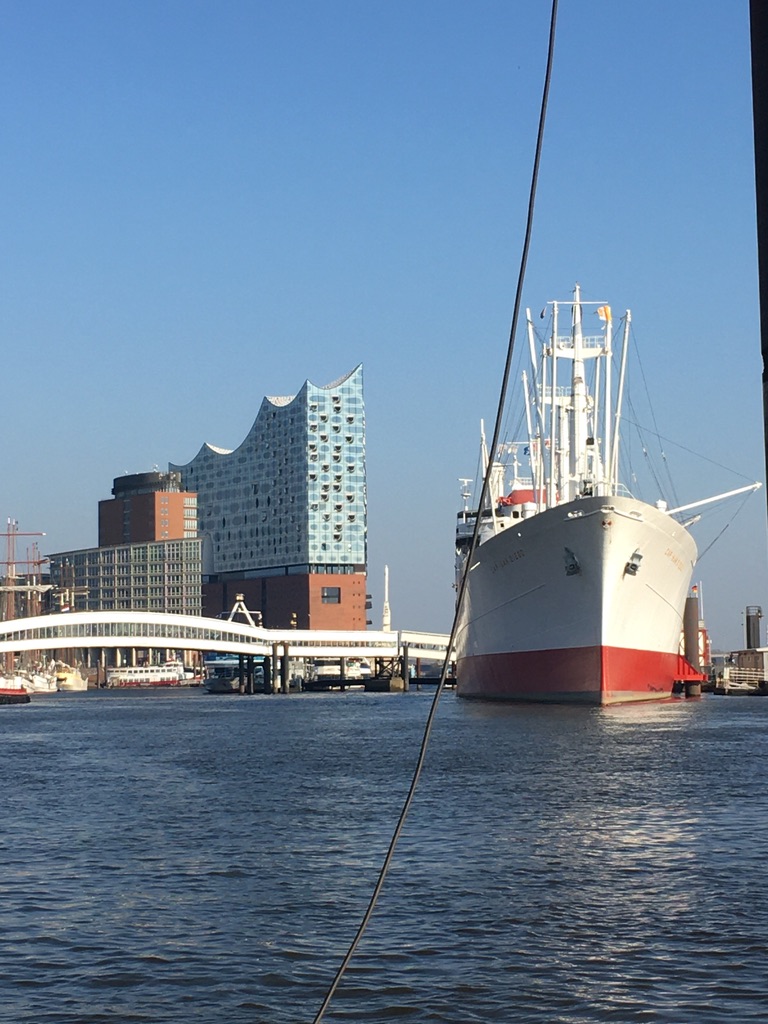
From there it is only a short run down to the water. We arrive at Landungsbrücken, Brücke 2. Here the tour, properly speaking, begins.
Enjoy a perfect view of the Elbphilharmonie during the harbour tour.
Return Journey to St. Ansgar Haus
Landungsbrücken
Over the past two years, as a lay historian, I have researched and documented the biography of a Jewish lawyer who lived in my flat until his death.
I could tell you a great deal about the Hanseatic tradition and the history of Hamburg, but we don’t have time for that today, so I will stick to my script. If you have questions, I am very glad to take them up again over the next few days.
Welcome to this unique tour of Hamburg. This tour focuses on Hamburg’s Erinnerungskultur, or culture of remembrance, and explores how the city and its citizens engage with and live with their history.
This isn’t about assigning blame. It’s about ensuring that forgetting is impossible.
As with anywhere, there are two sides to every story. We will visit places where the past and the present sit side by side.
During our boattrip we heard about Ballinstadt and the Emigration Museum. The emigration halls where millions passed through quarantine before crossing the Atlantic, a counterpart to Ellis Island in New York. The same harbour that sent people toward new lives later sent others toward their deaths.
Ballin Stadt Emigration Museum
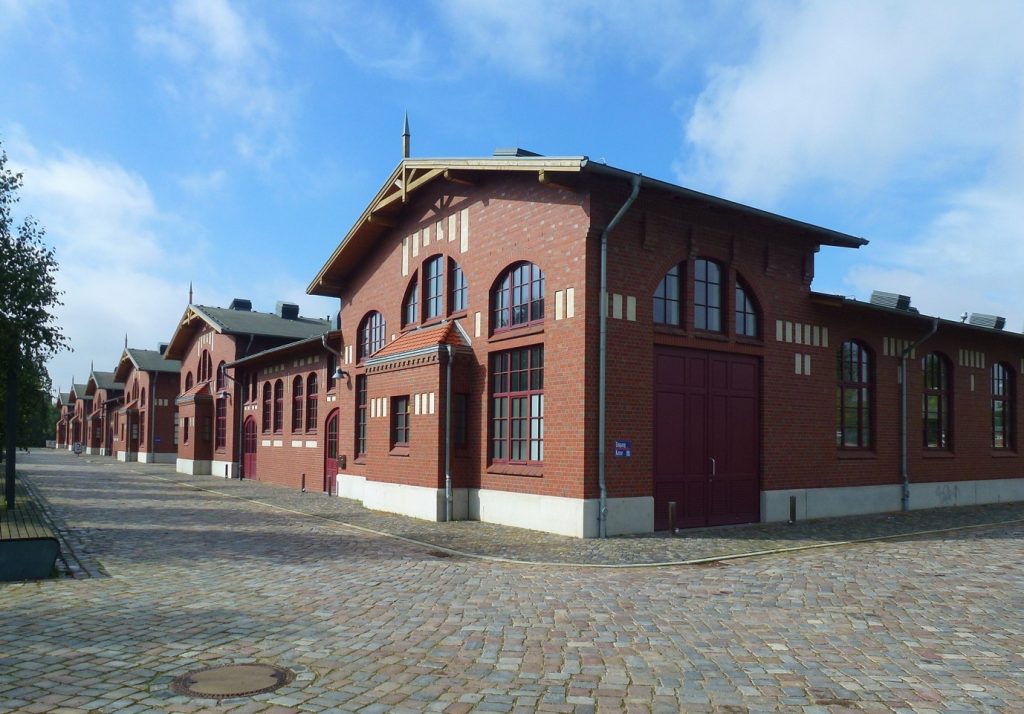
In the nineteenth and early twentieth century, this harbour was one of the great departure points of European emigration. Between 1850 and 1934, around five million people set off from here — to America, to Australia, to wherever another life seemed possible. The emigrant halls of the Ballin-Stadt on the Veddel — today the BallinStadt Emigration Museum — were built to house the tens of thousands who waited every year for their passage.
Albert Ballin, director of the Hamburg America Line, was one of the most influential figures this city has ever produced. He was of Jewish origin. He died on the 9th of November 1918 — the very day the Republic was proclaimed — almost certainly by his own hand. The National Socialists later erased his memory. His name disappeared from public life. His legacy was appropriated or destroyed.
The same harbour later became the site of a very different kind of departure. Not chosen. Forced.
For more information: https://ballinstadt.de/
Memorial Plaque for the Refugee Ship St. Louis at Landungsbrücke
We will talk about people whose lives were erased and a city that took a long time to acknowledge what had happened. The witnesses have now passed away. Remembrance is now a task for all of us. We must stand in the gap.
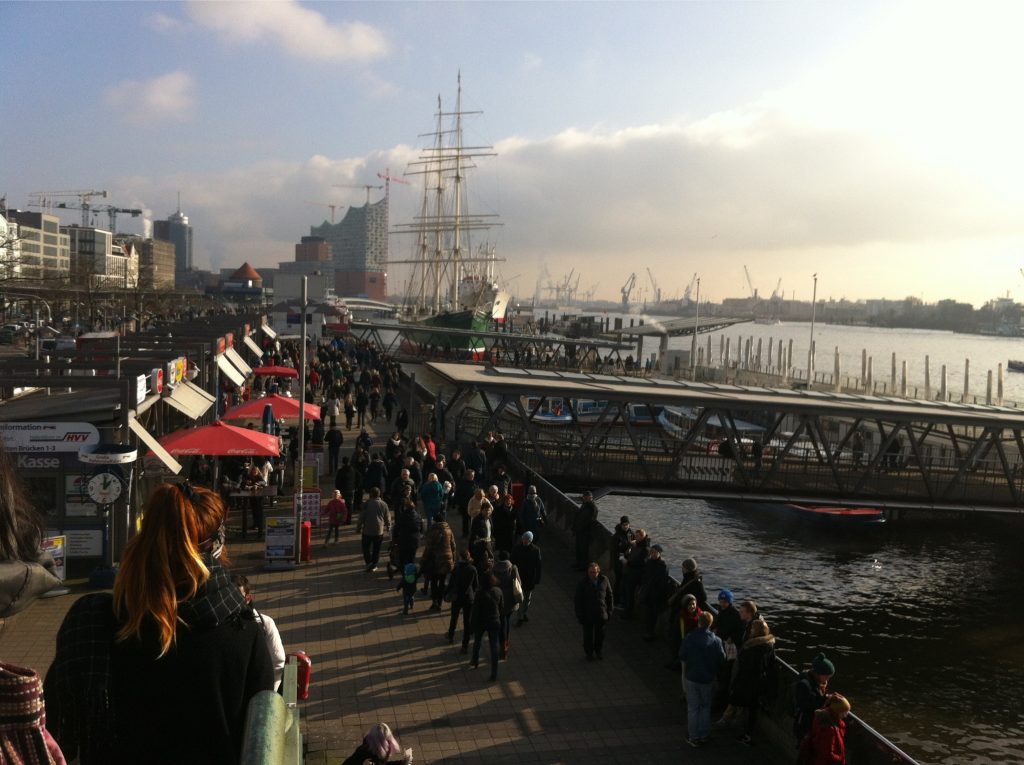
We begin at the Landungsbrücken — one of the most familiar places in Hamburg, and one that carries two very different stories.
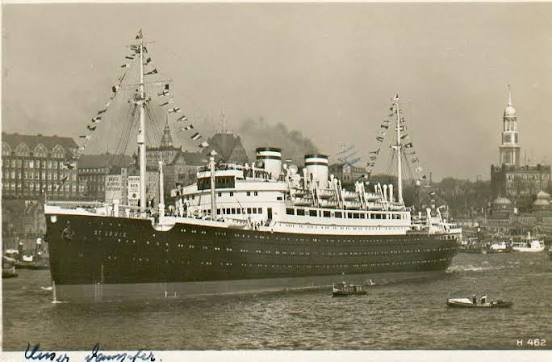
The memorial plaque commemorates the odyssey of the steamship „St. Louis“. On 13 May 1939, over 900 German-Jewish refugees sailed from Hamburg to Cuba aboard the ship, fleeing National Socialist persecution.
Cuba granted entry to only 23 passengers. The fate of the rest remained uncertain. The crew continued searching for a country willing to take them in.
The ship first anchored for several days off Havana. It then sailed to the coast of Florida, where the United States likewise refused to admit the passengers. Finally, the „St. Louis“ turned back towards Europe.
Belgium, Britain, France and the Netherlands agreed to take in the passengers. After 35 days, on 17 June 1939, the ship docked in Antwerp.
It takes little imagination to picture the conditions on board. The ship was built to carry around 400 passengers, not 900.
When the German Wehrmacht occupied the Netherlands, Belgium and France in 1940, many of the former refugees were captured, deported to concentration camps and murdered.
For more information: https://gedenkstaetten-in-hamburg.de/gedenkstaetten/zeige/gedenktafel-fuer-das-fluechtlingsschiff-st-louis
Fruchtschuppen C, the Harbour
HafenCity
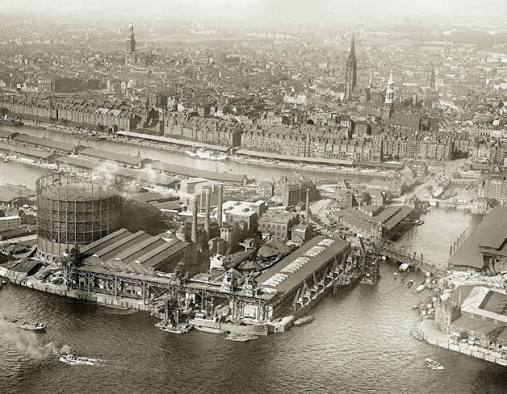
The development of HafenCity began after Hamburg’s decision in 1997 to convert former free-port land into a new urban district. Construction has been proceeding in phases since 2001, gradually transforming former logistics and warehouse areas into residential, cultural, and commercial spaces. The centrepiece of this development is the Elbphilharmonie concert hall, which was built between 2007 and 2016 on top of the old Kaispeicher A warehouse.
This warehouse was once used to store cocoa, tea and tobacco, but fell into disuse in the 1970s. Today, the glass concert hall stands atop the preserved brick base, symbolising Hamburg’s transition from an industrial harbour to a city with a contemporary cultural ambition
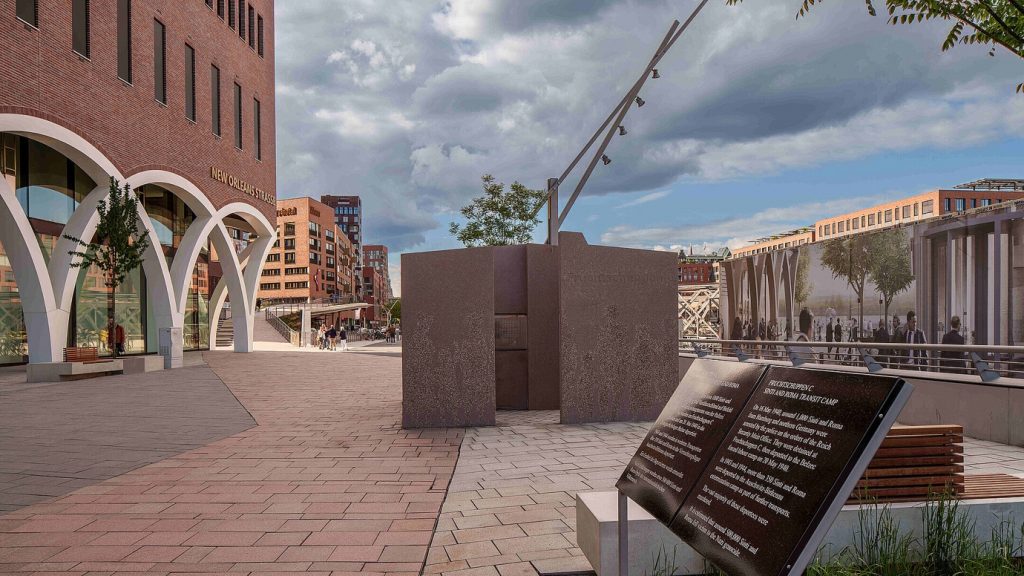
The Fruchtschuppen C was located where the HafenCity shopping centre is today. Within the shopping centre, on a square, you can find four memorial stelae providing information on the history of this place.
Around a thousand Sinti and Roma from Hamburg were rounded up and held here in May 1940. They were held for days without food, sanitation or explanation.
They were then deported by train to occupied Poland to work as forced labourers. Most of them did not survive the war.
This was not a concentration camp. It was a transit point in the middle of the city, run by the local authorities. The surrounding businesses continued to operate. Business as usual. Ships were loaded and unloaded.
The denk.mal Fruchtschuppen C — the name plays on the German word for memorial, Denkmal, split to read ‚think, for once‘ – one could translate it as re.mind. It opened in 2025, is one of the first memorials in Hamburg dedicated to the deported Sinti and Roma. We will meet their story again at the next stop.
For more information: https://gedenkstaetten-in-hamburg.de/gedenkstaetten/zeige/denkmal-fruchtschuppen-c
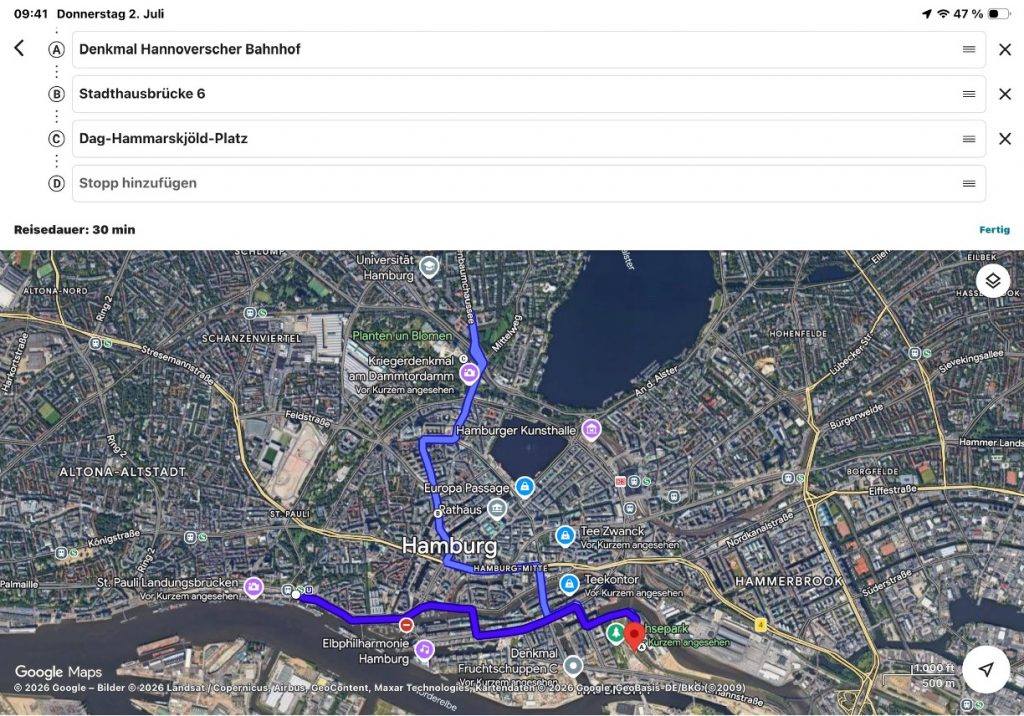
Hannoverscher Bahnhof / Lohsepark, HafenCity
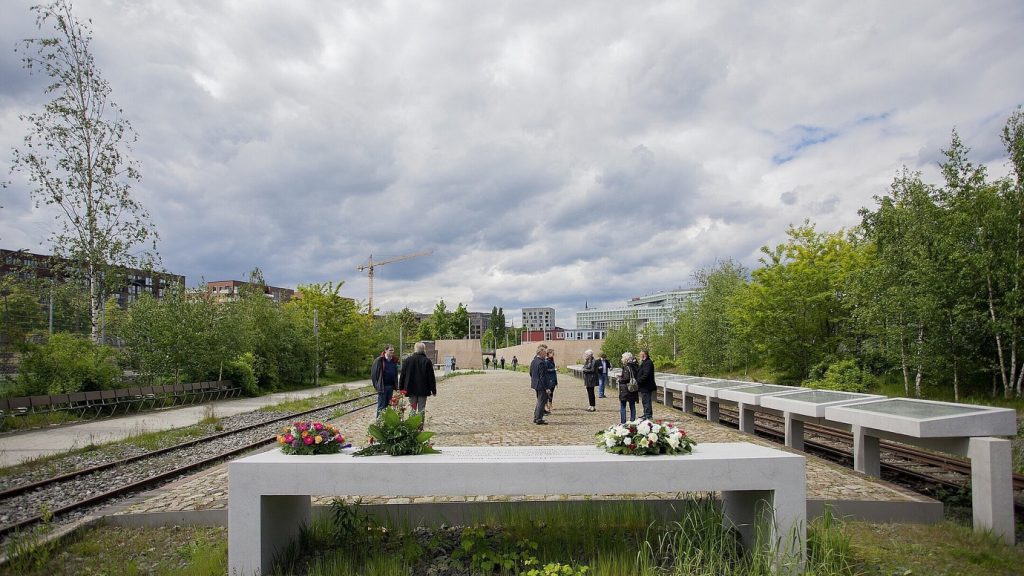
The trains left from here.
Between 1940 and 1945, more than eight thousand people from Hamburg and northern Germany were deported from this spot. The Hannoverscher Bahnhof once stood where this park now lies. The ruins of the grand entrance building was demolished in 1955.
For decades, this was just a goods yard. Then it became wasteland. It took years of civic pressure and collaboration between researchers and survivor associations before a memorial was built. A documentation centre is now under construction here. It is expected to open in 2026 or shortly thereafter.
The first major deportation train left Hamburg on 25 October 1941. It carried 1,034 people. Destination was the Łódź Ghetto. Only eighteen survived.
Subsequent transports went to Minsk, Riga and Theresienstadt. The Gestapo and criminal police rounded people up across the city — often at Moorweide, which we will visit later — and brought them here.
This is probably the first memorial in Germany dedicated to both Jewish and Sinti and Roma victims. That recognition was a long time coming.
For more informations: https://gedenkstaetten-in-hamburg.de/gedenkstaetten/zeige/denkmal-hannoverscher-bahnhof
As we leave the HafenCity and head towards the Altstadt, look right: the tower of St. Nikolai rises above the rooftops. Once one of Hamburg’s five great parish churches, its nave was destroyed in the bombing raids of 1943; the tower and ruin remain today as the city’s memorial to the war and its dead.
Stadthaus, Stadthausbrücke 6
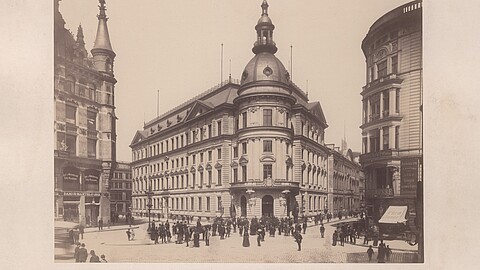
To your right is the Stadthausbrücke building complex. It is unremarkable from the outside. It is a municipal office today, just as it was before.
From 1933 to 1943, however, it was the headquarters of the Gestapo — the Geheime Staatspolizei, or Secret State Police — in Hamburg. People were brought here and interrogated. Interrogation often meant torture. The decisions made in these offices determined people’s fates: release, a concentration camp or deportation.
Many of the stories behind the Stolpersteine we are about to see lead back to this building. This is where those people’s fates were decided.
The building wasn’t designed for terror. It was an ordinary administrative block in an ordinary city, in plain sight of everyday life going on around it. This ordinariness matters. Hannah Arendt called this the banality of evil. It was not an exception. It was bureaucratic practice in the middle of the city.
For more information: https://gedenkstaetten-in-hamburg.de/gedenkstaetten/zeige/geschichtsort-stadthaus
Dammtor Station: the Memorial Ensemble
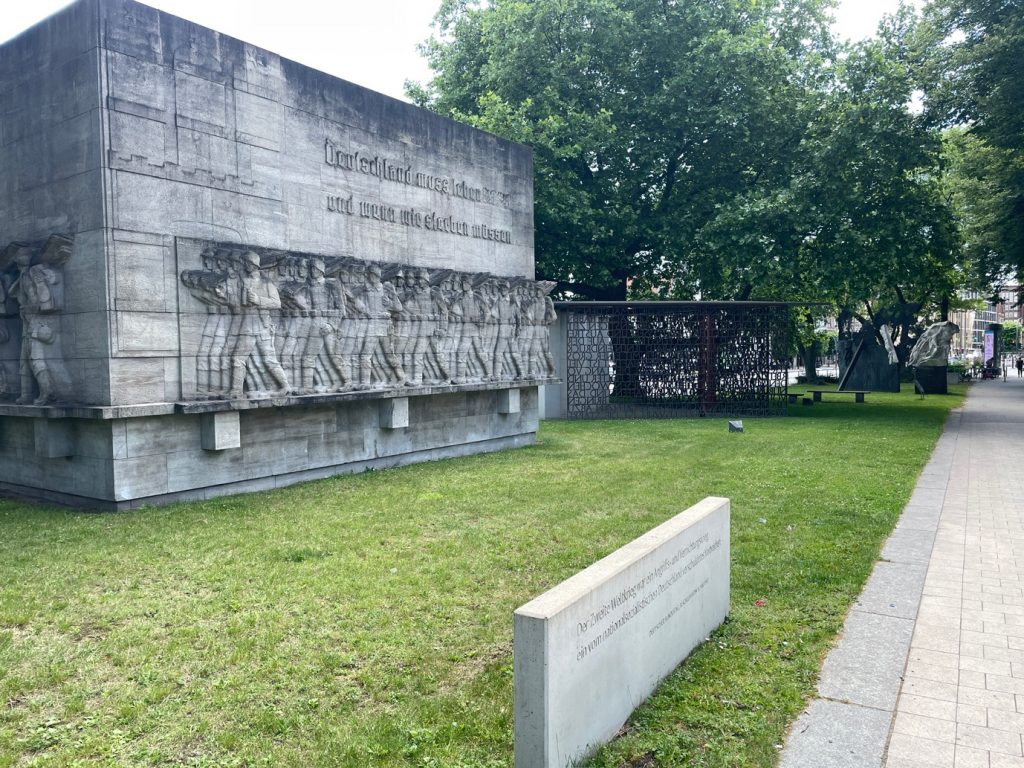
Just a few metres apart, four very different objects stand side by side. Nowhere else in Hamburg packs so much contested history into such a small area.
The war memorial — the Kriegsklotz (1936)
This seven-metre limestone block was erected by veterans of the 76th Infantry Regiment and unveiled by the National Socialist Senate of Hamburg. Around it is a relief depicting eighty-eight life-sized soldiers marching. The inscription reads: Germany must live, even if we must die.
The monument survived the Allied bombing raids.
It also survived post-war debates about removing it. In the 1970s, it became a regular flashpoint for neo-Nazi marches and anti-war protests. It was daubed with paint, attacked and even hit by small explosive charges.
The Bundeswehr stopped holding ceremonies here in the 1970s. And yet it’s still standing. It remains unresolved and contested, neither demolished nor rehabilitated. This alone serves as a testament to the challenges of German remembrance.
Alfred Hrdlicka’s counter-memorial (1985 to 86)
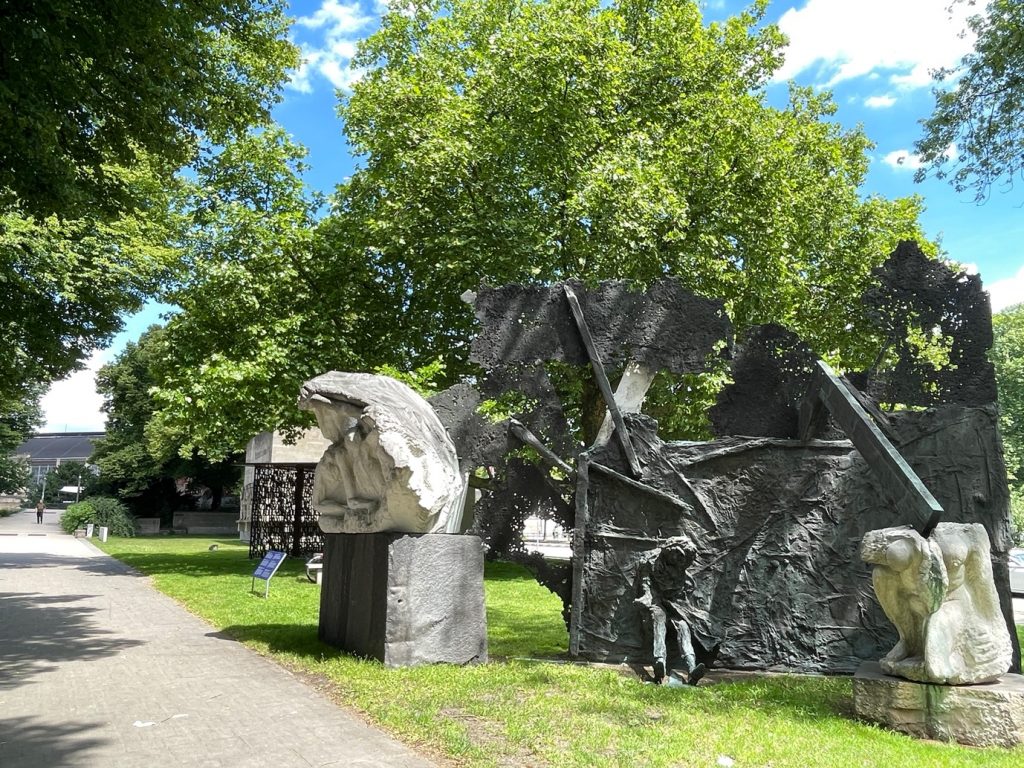
The Austrian sculptor Alfred Hrdlicka planned a four-part anti-war monument to be erected next to the Kriegsklotz. However, only two parts were ever completed.
The first, titled ‚Hamburg Firestorm‘, depicts civilian victims of the Allied bombing in July 1943, in which tens of thousands of Hamburg residents lost their lives.
The second part, ‚Fluchtgruppe Cap Arcona‘, commemorates 3 May 1945, just days before the war’s end, when the Royal Air Force sank the Cap Arcona in Lübeck Bay carrying concentration camp prisoners who had been evacuated from Neuengamme.
The pilots had not been informed of this intelligence, which had reached British command the day before.
Almost 7.000 people drowned or were burned to death. By way of comparison, 1.500 people died when the Titanic sank.
The counter-memorial was never completed – „Soldier’s Death“ and „Women under Facsism“ are missing.
Over time, this unfinished state has become part of its significance.
The Deserters‘ Memorial (2015)
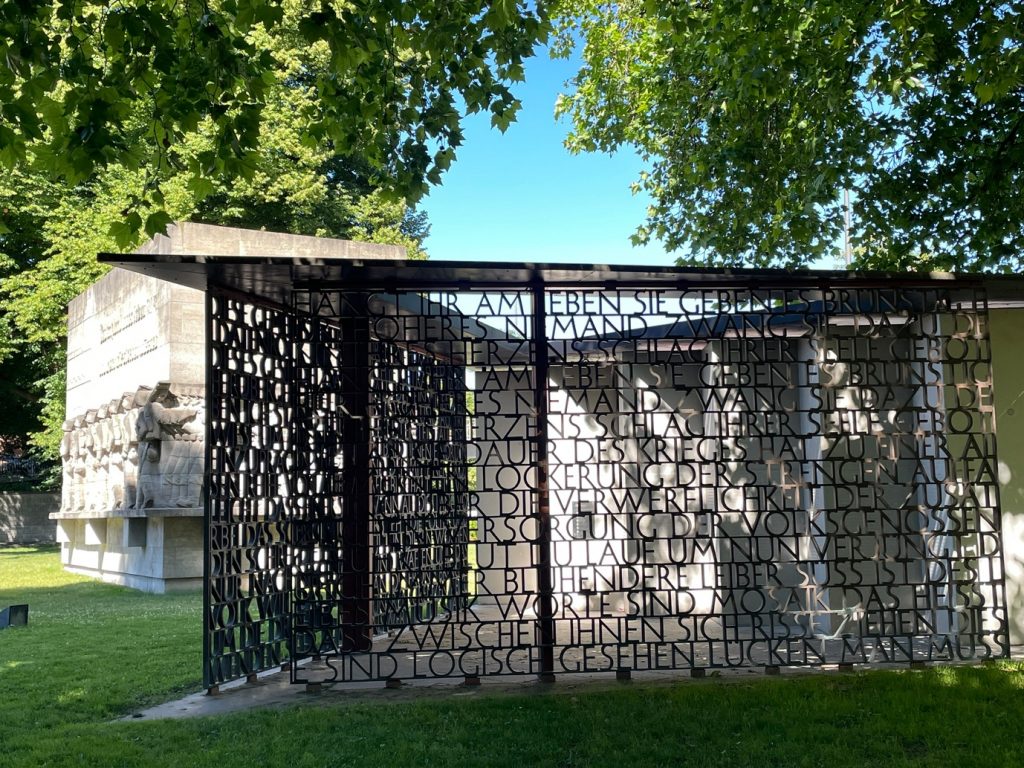
Volker Lang’s A Quiet Stone is easy to walk past, nestled beside its larger neighbours. It commemorates soldiers who refused to fight and were executed for it by military courts. For decades after the war, West German courts upheld these sentences as lawful. The men were not seen as victims, but as traitors. Full legal rehabilitation only came in 2002. Compensation followed, albeit belatedly, and for many, it came too late.
The railings
The bronze railings around this triangular square are made of text, words from Helmut Heißenbüttel’s Deutschland 1944. Even the boundary of the memorial becomes something you can read.
For more information: https://gedenkstaetten-in-hamburg.de/gedenkstaetten/zeige/gedenkort-fuer-deserteure-und-andere-opfer-der-ns-militaerjustiz
Who is missing
One notable absence is worth mentioning. Among the victims of Nazi persecution were homosexual men, who were prosecuted under the tightened Paragraph 175.
This law, which came into effect in 1935, massively expanded the criminalisation of homosexuality. In the camps, they were forced to wear a pink triangle and were at the bottom of the prisoner hierarchy.
They were exposed to deliberate brutality from guards and often from other prisoners, too. Their death rate was among the highest of any group: at Neuengamme, for example, it was close to ninety per cent.
After 1945, they were denied compensation for decades because Paragraph 175 remained in force until 1969 and was not fully repealed until 1994.
There is a memorial to homosexual victims at the Neuengamme site in Hamburg. But not here. This is a gap worth acknowledging.
The question
The questions asked here are not only historical. In 1946, Karl Jaspers identified four types of guilt.
1. Criminal guilt is for the courts to decide.
2. Political guilt, which was shared by everyone who belonged to a criminal state.
3. Moral guilt, which each person must work out alone.
4. Metaphysical guilt is the quiet, shared responsibility of everyone who was alive at the same time.
Jaspers kept these categories strictly separate. He knew that blurring them would lead to injustice.
Dammtor Station: the Kindertransport Sculpture „The Final Parting“
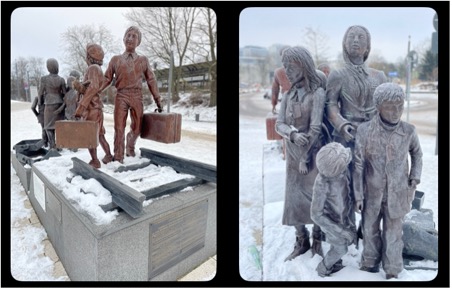
We are standing in front of a bronze sculpture by the artist Frank Meisler, which was unveiled in 2015. Kindertransport: The Final Parting.
The sculpture depicts two groups of children standing back-to-back on a platform, waiting for different trains. The smaller group will be saved. The larger group will not survive.
Between December 1938 and 1 September 1939 — the day Germany invaded Poland, bringing the programme to an abrupt end — around a thousand Jewish children from Hamburg were able to leave for Great Britain.
In total, approximately ten thousand children were rescued in this way across Germany, Austria and Czechoslovakia. Most of them never saw their parents again. For many of them, this was the last place they stood on German soil.
Frank Meisler was familiar with the story of the Kindertransport from personal experience. He was thirteen years old when he was rescued on one of the final transports from Danzig in August 1939, just days before the German invasion.
Shortly after he left, his parents were arrested and deported to the Warsaw Ghetto. They were later murdered in Auschwitz. He became a sculptor in Jaffa and created a series of Kindertransport memorials along the route taken by the children: at Liverpool Street Station in London, Friedrichstraße Station in Berlin, Danzig and Hoek van Holland.
Together, these memorials form a chain of memory across Europe.
The sculpture here was financed entirely through private donations. Not a single euro from the public purse. This too is part of Hamburg’s history of remembrance.
For more information: https://gedenkstaetten-in-hamburg.de/gedenkstaetten/zeige/denkmal-kindertransport-der-letzte-abschied-the-final-parting
Now, we will head to Moorweide, which is located on the other side of Dammtor train station.
Ernst Cassirer Park and the Square of the Jewish Deportees
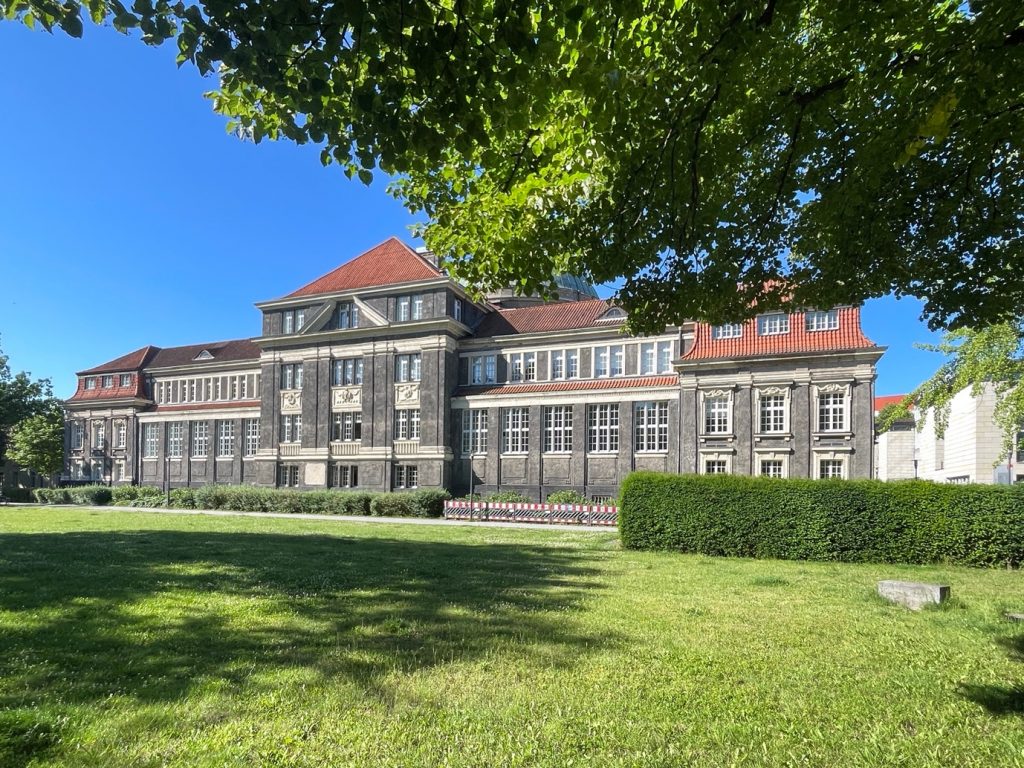
The small park behind the main university building has a name that deserves a moment of your time.
Ernst Cassirer was born in Breslau in 1874. In 1919, he became one of the founding professors at the newly established University of Hamburg.
In 1929, he became its rector — one of the first Jewish rectors of a German university during the Weimar Republic.
He was a renowned philosopher. His central question was how human beings construct reality through language, myth, science and art. Not as separate human activities, but as different symbolic forms, each of which shapes how we see the world.
When Hitler became chancellor in January 1933, Cassirer immediately understood what this meant. He left Germany in March of that year, before the first professional exclusion laws came into force. He never returned. He taught at Oxford, Gothenburg, Yale and Columbia universities. He died in New York in April 1945, just a few weeks before Germany’s surrender.
The largest lecture theatre in the building behind us is named after him.
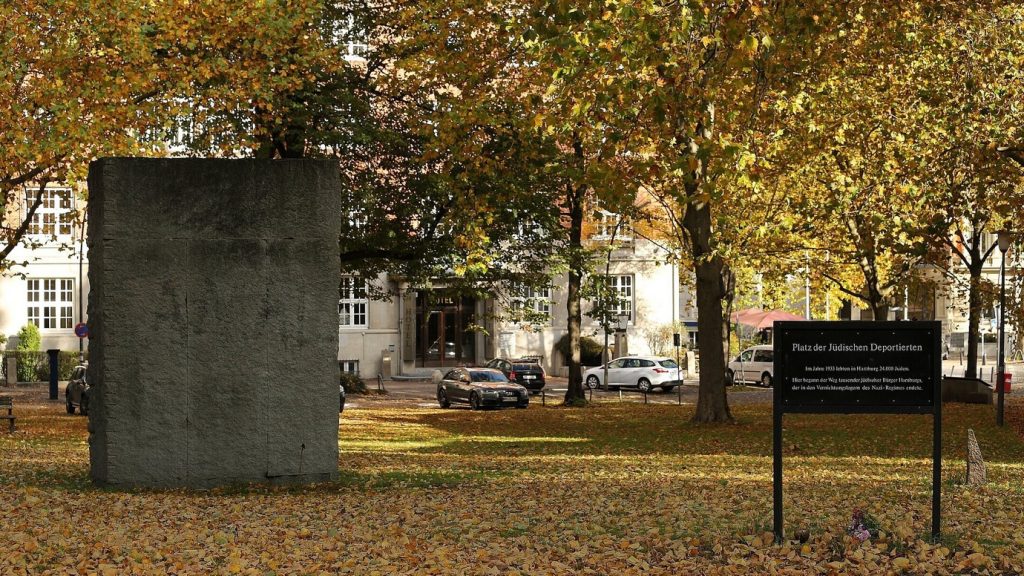
The Square of the Jewish deportees, located beside us, marks Moorweide as one of the main assembly points for Jewish deportees in Hamburg. The gatherings themselves took place in the green space of the Moorweide. The memorial stands at the edge of the Moorweide because it is still used for public events today.
People were taken from their homes, increasingly from so-called ‚Judenhäuser‘ (Jewish houses), where Jewish families had been forced to live together in overcrowded conditions.
They were brought here. Sometimes they waited for hours in the open air, watched by passers-by. Then, they were loaded into police vans and taken to the Hannoverscher Bahnhof, which we saw earlier.
The Grindelviertel, the district immediately behind the university, was the centre of Jewish life in Hamburg until 1933. There were synagogues, schools, cafés, publishing houses and medical practices. A complete world. Within a decade, it was gone.
For more information: https://gedenkstaetten-in-hamburg.de/gedenkstaetten/zeige/mahnmal-am-platz-der-juedischen-deportierten
Stolpersteine, Edmund-Siemers-Allee 1
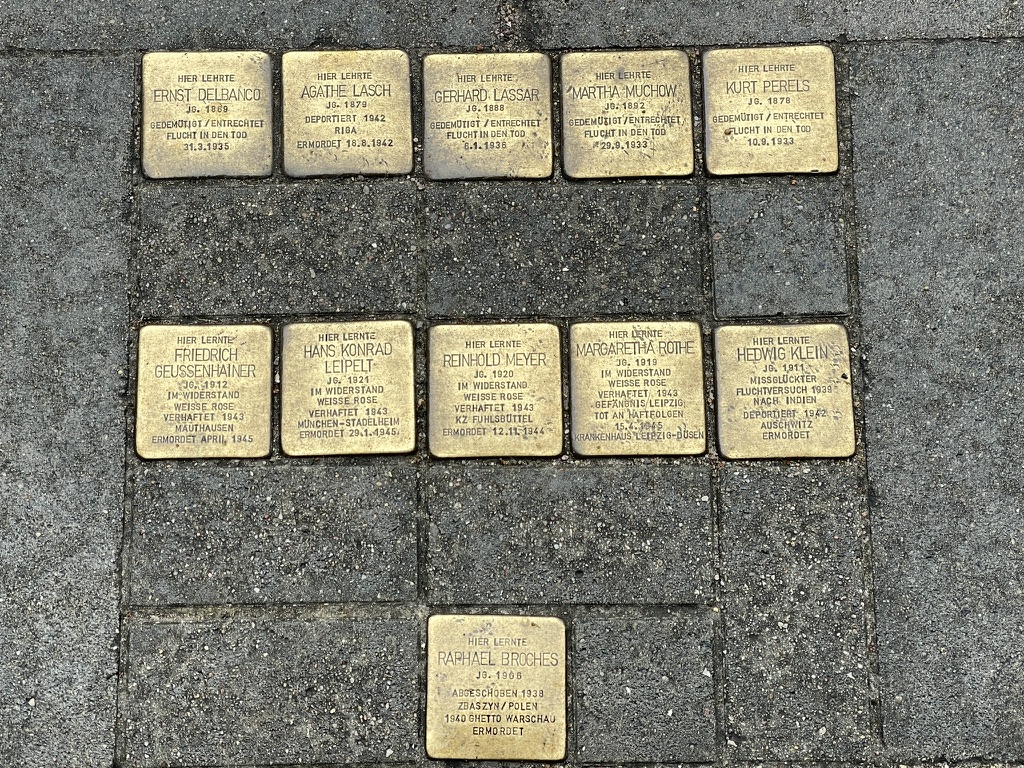
The small brass plaques that we are about to read are the work of Gunter Demnig, a Berlin-born artist. The idea for them emerged in 1992/93. Since then, the project has grown to encompass over 115,000 stones laid in more than 2,000 communities.
Stolpersteine now exist in over thirty European countries — wherever the Wehrmacht, the SS, and the Gestapo operated. It is the world’s largest decentralised memorial.
Each stone is handmade — each letter is hammered into the brass by hand, then the stone is set in concrete. Demnig still attends most installations in person, as it matters to him that they are carried out carefully, in the right place and in the presence of family members or the local community.
A pupil was once asked by a journalist whether it was possible to actually stumble upon the stones. He replied, ‚You stumble with your head — and with your heart.‘
At our feet are small brass squares set into the pavement. Each one is ten centimetres across and hand-stamped with a name and fate.
In Hamburg alone, more than seven thousand have been laid — more than in any other German city. Over ninety per cent of them bear Jewish names. The rest commemorate victims of forced euthanasia, political opponents, Jehovah’s Witnesses, Socialists, Communists and others who were persecuted. Each stone costs 120 euros and is funded by private individuals or descendants. Each one marks the last place where that person lived in freedom.
These three stones tell very different stories that end up being the same story.
Agathe Lasch (1879–1942) was the first woman to be appointed as a full professor of Germanic philology at this university, in 1923. She was a recognised specialist in Low German dialects. In 1933, she was dismissed under the Law for the Restoration of the Professional Civil Service — one of the first laws enacted by the National Socialist regime to remove Jews and political opponents from public employment. She remained in Hamburg. She could not emigrate. In 1942, she was deported to the Riga Ghetto, where she was murdered.
Hedwig Klein (1911–1942) was one of the last Jewish students permitted to enrol on a doctoral programme at this university. In 1937, she completed a serious piece of scholarly work for her dissertation in Semitics. However, she was no longer officially permitted to submit it because Jews had already been excluded from academic qualifications by that point. She submitted it informally. In 1942, she was deported to Auschwitz and murdered. In 2011, the University of Hamburg awarded her the doctorate posthumously. It had taken sixty-nine years.
Martha Muchow (1892–1933) was not Jewish. She was one of the first women to hold a senior research position at a German university, specialising in developmental psychology and becoming renowned for her studies of how children experience urban spaces. Following the rise of the National Socialists, she was forced to resign. She took her own life in September 1933, becoming one of the year’s earliest victims and a reminder that the definition of the unwanted was not limited to one group.
Three women. Three forms of erasure.
Conclusion, Edmund-Siemers-Allee
Conclusion, Edmund-Siemers-Allee
We are standing on the edge of Grindelviertel and at the limit of what can be covered in a one-hour tour.
We haven’t covered everything.
For example, we haven’t discussed the fate of the Communists and Social Democrats, many of whom were Hamburg dock workers and trade unionists. They were the first to be arrested in 1933 and imprisoned for the longest time. They were punished with death for their resistance by Hanseatic courts.
Nor have we spoken about the twenty children who were murdered at the Bullenhuser Damm School just three weeks before the end of the war, in order to destroy the evidence of the medical experiments that had been performed on them.
As I am a passionate swing dancer myself, one group we have not yet mentioned deserves at least a sentence because their story is so specific to Hamburg: the Swing Youth.
In the 1930s, Hamburg was at the heart of a youth movement that refused to march in step — quite literally. One evening at the Curio-Haus, more than five hundred young people gathered to dance to American jazz and swing. They wore their hair long and English clothes, and used English nicknames. They called themselves the Swings. The regime branded them as ‚asocial‘ and ‚degenerate‘. The music was considered a threat — it came from America, it had black roots and it allowed the body to move freely.
From 1940 onwards, the police regularly raided Swing gatherings. Then, in August 1941, an immediate crackdown — the ‚Sofort-Aktion gegen die Swing-Jugend‘ — was launched, resulting in the arrest of over three hundred young people. Reprisals ranged from having their long hair cut off and being expelled from school to being placed in protective custody and deported to concentration camps. In Hamburg alone, between forty and seventy young people were sent to the camps.
This was not political resistance in the conventional sense. It was a resistance to the imposed march through the assertion of one’s own rhythm. For the regime, that was enough.
A culture of remembrance can never be complete because remembering is an ongoing process. Hamburg was slow — slower than it should have been. The entrance building of the deportation station Hannover Bahnhof was demolished in 1955. The memorial at Fruchtschuppen C was inaugurated in 2025. The documentation centre opened in 2026, eighty years after the events it documents. The legal rehabilitation of the deserters came in 2002. These delays are now part of history.
Viktor Frankl, a neurologist, psychiatrist and Auschwitz survivor, warned against judging people too harshly. Not because judgement is inappropriate, but because it presupposes a right that only belongs to those who have shown the same courage themselves.
We do not know how we would have reacted.
However, memory lives on — decentralised, sometimes contradictory, and sustained not primarily by the state, but by individuals. Awareness of history leads citizens to sponsor a Stolperstein and clean it once a year. Or descendants who travel from New York or Tel Aviv to read a name on a Hamburg pavement. Researchers who campaigned for decades for a memorial that the city did not want.
The stones are small. They are set into the ground so that you cannot overlook them — you have to bend down to read them. This is no accident.
Notes
Neuengamme Concentration Camp
Prisoners at Neuengamme were beaten, drowned, hanged, shot or killed with gas. They starved, died of hypothermia, exhaustion, untreated disease and medical experiments — tuberculosis bacteria injected under the skin, contaminated water administered. Of around 100,000 prisoners, at least 50,000 died.
The camp held Jews, Sinti and Roma, homosexual men, Communists, Social Democrats, Soviet prisoners of war, Danish and Norwegian resistance fighters, French, Dutch, Belgian and Polish prisoners, Jehovah’s Witnesses, and people classified as asocial. Each group wore a coloured triangle: red for political prisoners, yellow for Jews, pink for homosexual men, purple for Jehovah’s Witnesses, black for those classified as asocial, brown for Sinti and Roma.
Bullenhuser Damm
In April 1945, twenty Jewish children aged between five and twelve, on whom SS doctors had been conducting tuberculosis experiments since November 1944, were brought to a former school at the Bullenhuser Damm and hanged there — together with four adult prisoners who had cared for them — in order to destroy the evidence. A rose garden bearing the children’s names is accessible at all times.
Further sources:
Neuengamme Concentration Camp Memorial: www.kz-gedenkstaette-neuengamme.de
Stolpersteine Hamburg: www.stolpersteine-hamburg.de
© Thorsten Grigat 03.07.2026